The Cooperation Kettle

Buffalo, New York City, Brooklyn, Long Island, NY. Phoenix, AZ. Raleigh, NC. Charleston, Columbia SC. Milwaukee, Madison, WI. Minneapolis, MN. Denver, CO. Eugene, Portland, Salem, OR. Richmond, VA. Seattle, WA. Los Angeles, Berkeley, Scotts Valley, Orange County, CA. Fort Wayne, IN. Toronto, Ottawa, Montreal, CAN. Boston, MA. Chicago, IL. Tulsa, OK. Columbus, OH. Tallahassee, Orlando, FL. Salt Lake City, UT. Austin, TX. Pittsburgh, Philadelphia, PA. Las Vegas, NV. Boise, ID.

Organizers in every city have the same story to tell: the radical energy brought forth by the deaths of George Floyd and Breonna Taylor— the radical energy to dismantle our violent, anti-Black, and anti-poor policing system— has been co-opted overnight.

In Los Angeles, Seattle, and New York City, protests have been overtaken by unaffiliated activists who have refused to relinquish the microphone to event organizers or have brought their own sound systems to control and direct the crowd.

In Denver, protesters have been led into police kettles by groups that won’t declare their leaders. In Madison and Richmond, events have been staged in surveillance theaters: nonviolent protests appear left alone by cops, only to later discover them watching from rooftops, museums, and vacant offices.

Around the country, the story is the same: radical energy— the kind forcing politicians’ hands to slash police budgets, demilitarize local forces, and arrest murderous officers— has transformed into cookouts, music festivals, and explicitly non-disruptive (not just non-violent) actions. Police have negotiated “police-free zones” where community leaders agree to police their own in exchange for a family-friendly event with activities for the kids.

For days police deployed gas, flash-bangs, and both rubber and live bullets at us. Then suddenly, the violent confrontations seemed to stop. In their place stands the Negotiators and Mediators: a class of often (but not always) brand-new or unaffiliated activists who promise to control and quiet the riots that have proven so effective in forcing change. The Negotiators promise that they can do what the police cannot: control us. They promise to stand between us and the police, and at times have literally done so with their bodies. They have hugged cops in front of us, days after we were gassed and shot at without provocation. They coordinate protest routes with police. They hold vigils for dead cops. They tell us to remain peaceful.

Down the street, the story is not the same. Here in Madison, nonviolent protesters have been grabbed by police snatch vans while dispersing. The violence hasn’t ended, it has been hidden. While the organizers proudly proclaim “No arrests tonight!” black youth sit in jail cells across the country for their civil disobedience at those very events.

You see, for the police there is no such thing as negotiation. There is cooperation, and there is violence. These strategies, perfected and optimized during Occupy Wall Street, Standing Rock, and other autonomous zone protests, are meant to take from us the one thing we have: our capacity to point out, clear as day, the violence the state wields against us for simply refusing to continue operating in a world where Black people are murdered and imprisoned to grease the machines of our economy and country.

These tactics were described at length in the Army’s Civil Disturbance Operations (2005).

“Working relationships between commanders and protest group leaders are increasingly seen as the best means for preventing bad outcomes in a crowd situation. This is called the negotiated management model of crowd control… Open dialog helps develop working relationships between commanders and protest group leaders… It also allows authorities and commanders to tell group leaders what they are prepared to do and how they might respond to certain crowd behaviors… Negotiations may also encourage more moderate leaders to do things that will support the commander...

Commanders should make a concentrated effort to maintain a working relationship with the leaders of protest groups. Communication also means persuasion. Commanders should make a concerted effort to win over demonstration leaders… They should encourage demonstrators to protest in an acceptable way and, if possible, offer favors to get them to do just that.


Working relationships between commanders and protest group leaders often result in protest groups policing themselves. This is one of the basic premises of negotiated management.“

p. 2-7 (emphasis added)

The police, who are themselves constantly militarizing through trainings designed to simulate war and military acquisition programs such as 1033, have unsurprisingly begun drawing from the psychological warfare tactics of the Army themselves. As one dear friend said, the police are like any other abuser: they shoot at you one day, and then beg you to let them change the next. “I just want to be different. I kneel before you. I want to change.” Bullshit.

In this all, we can’t ignore the role of the Negotiator class. As Fanon argued, their cooperation leads us straight into yet another kind of kettle: the open arms of the police who promise hugs but deliver brutality. He writes,

“This idea of compromise is very important in the phenomenon of decolonization, for it is very far from being a simple one. Compromise involves the colonial system and the young nationalist bourgeoisie at one and the same time. The partisans of the colonial system discover that the masses may destroy everything. Blown-up bridges, ravaged farms, repressions, and fighting harshly disrupt the economy. Compromise is equally attractive to the nationalist bourgeoisie, who since they are not clearly aware of the possible consequences of the rising storm, are genuinely afraid of being swept away by this huge hurricane and never stop saying to the settlers: “We are still capable of stopping the slaughter; the masses still have confidence in us; act quickly if you do not want to put everything in jeopardy.” One step more, and the leader of the nationalist party keeps his distance with regard to that violence. He loudly proclaims that he has nothing to do with these Mau-Mau, these terrorists, these throat-slitters. At best, he shuts himself off in a no man’s land between the terrorists and the settlers and willingly offers his services as go-between; that is to say, that as the settlers cannot discuss terms with these Mau-Mau, he himself will be quite willing to begin negotiations. Thus it is that the rear guard of the national struggle, that very party of people who have never ceased to be on the other side in the fight, find themselves somersaulted into the van of negotiations and compromise–precisely because that party has taken very good care never to break contact with colonialism.“

Fanon, The Wretched of the Earth, p. 61

The Cooperation Kettle is the one we are lead into by our own people, our own community leaders, our own well-intentioned politicians. Perhaps it is their class position gives them a different set of incentives, perhaps they are grifters, perhaps they are paid, and perhaps they are just brand new. The outcome is the same. We are promised a settlement, but we receive only more settlerism, more colonialism, more domination. We are told that training will save us when an abundance of data contradicts. We are told it’s not all cops, when we can see the system of policing converts even the kindest and most well-intentioned recruit into a fearful pig at war with his community and equipped with weapons not even legal for you and I to own.

We have a choice now. We can wait. We can wait until the next Black man dies in a chokehold or the next Black woman is murdered at a traffic stop. We can wait until the next elderly man cracks his skull open on the concrete. We can wait until the next young woman dies from an allergic reaction to the tear gas police are spraying. We can wait until something sparks our rage again.

I say we don’t wait. I don’t have all the answers, but I don’t think we can afford to wait. I don’t think Black Lives Matter if we wait for more death. I don’t know how to retake what we must, I don’t know how we agitate to get back what we had, but I know the present is the only guarantee we have.

It’s Not Culture War, it’s Class War and Race War

The ruling class of this nation largely does what it wants to do.

Anyone who has participated in protests over the last ten years will tell you a familiar story: protesters gather, create a spectacle, and return home. The gears of power and wealth grind on uninterrupted. The politicians pass the bills they wanted to pass, then scurry back to their homes in the wealthiest and whitest neighborhoods of the polities they claim to represent. A protest, on its own, has a negligible impact on our political future.

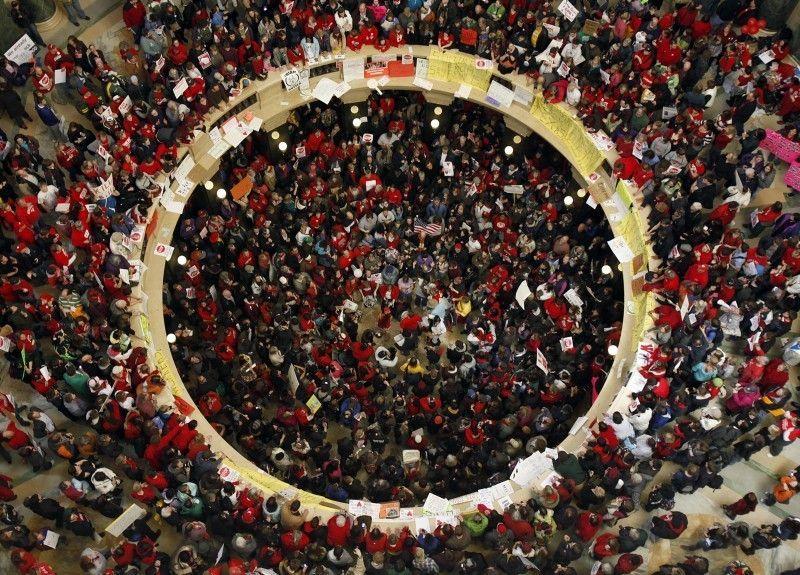
In Wisconsin, we know this process all too well, as politicians at the state, county, and city level pass bill after bill against the super-majoritarian dissent of our communities. Consider, for example, the protests against Scott Walker’s union-busting Act 10. The protests wrapped for miles around and continued on for weeks. The Wisconsin State Journal reported that tens of thousands of people attended.

They packed the capitol square:

They filled the interior of the capitol building like sardines:

Hell, protesters even slept on the floor, hoping to be one of the few able to make it into the over-stuffed hearing rooms:

If there was ever a protest that could pressure politicians into carrying out the will of the people, these were those protests.

But, the ruling class had its agenda. Business owners hoping to gut public provisions and cash in on the vacuum wanted public sector unions busted. And busted they were, from teachers to sanitation workers.

Compare the Act 10 protests to this week’s anti-quarantine rally, and you might even feel relieved (though I will argue you shouldn’t). The few hundred protesters in attendance couldn’t cover the green on a single corner of the capitol, much less wrap the capitol and surrounding streets. There were so few people, they wouldn’t have put the capitol building at capacity if they had gathered inside instead. Have a look:

Protesters demand Wisconsin governor to reopen state as ...

There’s nothing wrong or shameful about a small protest. (Though, there’s plenty shameful about downplaying the severity of a destructive pandemic because you are impatient to return to consumerist comforts like salons and brunch.) Every movement has to start somewhere. But there’s something very off about these small protests.

We’re being lead to believe they are working.

The Washington Post claimed the president was “siding with protesters.” The Atlantic called it a “Culture War” between polarized citizens. Politicians from top to the bottom have celebrated the protests as their democratic authorization to act. Four states have lifted their quarantines, with more stay-at-home orders set to expire before the weekend. Their calls to reopen non-essential, consumerist businesses like shopping malls and vacation resorts have been retold as the passionate amplification of community consensus. They are merely bending to the will of The People, spoken through loud congregations of our democratic will.

Now THAT is fucking bonkers.

Data collected by political scientists and the Wisconsin Center for Investigative Journalism both confirm that these politicians have never in their careers acted according to the will of the people. In Wisconsin, our own history is enough to know this. Far, far larger protests than these have been laughed away by oligarchs who are either exceptionally powerful themselves or in the pocket of those who are.

If it seems a bit strange to you that these champions of oligarchy are suddenly claiming to be acting on behalf of you and I, your instincts are solid. Let’s dig into what we know about these protests.

For one, the protesters are unlike the vast majority of protests I’ve attended around the country. Whereas pro-union/worker protests are typically overwhelmingly attended by working class and/or poor members of the community, the anti-quarantine protests have been populated by a shocking number of business owners, such as the self-identified “boss” of Real Milwaukee CBD and owner/president of Sebring Garage, the owner of Collura Financial, a variety of Wisconsin landlords, and a host more restaurant, salon, and hotel owners.

To be fair, there were also genuinely working-class people in attendance. They are (reasonably) terrified that the tax money they’ve paid into the state will not be used to their benefit when they need it the most. Rather than demanding a proper safety net for their community, they have joined forces with business owners who are protesting because they are interested in maintaining a level of wealth and equity far beyond what most of us are paid for a full year of work under the best circumstances.

The disproportionately high turnout from bosses and managers is consistent with the overall top-down character of anti-quarantine political momentum. First, there is the roster Fox News recently released of advisors tasked with reopening businesses as quickly as possible:

God help us': Americans horrified after Trump names Jared and ...

Far from the motivations, desires, and needs of everyday people, the council is made up of the economic elite. There’s Mark Meadows, a real estate mogul whose multi-million dollar net worth placed him among the richest recent members of congress. And Ivanka Trump, whose familial wealth has opened doors for her from hedge fund management to a line of jewelry available from the U.S. to Saudi Arabia. Then there’s the $600 million man, Wilbur Ross, Mnuchin’s $400 million, and so on down the line to Kudlow’s comparatively paltry $25 million net worth.

Second, there’s the suspiciously astroturfed nature of these protests. As the Times reports, anti-quarantine rallies around the country have been “backed by well-funded interest groups” linked back to organizations who advocate for further shifting power away from workers and towards bosses, and away from tenants and towards landlords. Here in Wisconsin, that’s included pro-business lobbying groups and thinktanks like the MacIver Institute; in neighboring Michigan, it’s been groups linked to the anti-public school interests of multi-billionaire Betsy DeVos.

When it comes to questions of policy–who the government should favor in confrontations between corporations and consumers, developers and residents, or CEOs and workers– the drivers of anti-quarantine momentum are people who have entirely different interests and motivations than the vast majority of people.

Little about the supposedly democratic nature of these protests is true. This is no culture war between competing factions of neighbors. This is a class war waged by our bosses and landlords against the rest of us. It is fueled by the deep-seated bigotry taught through America’s ongoing race war against black, brown, and native communities. Because the lives and labor of racial minorities are continually devalued, corporate fat cats have been able to build a surplus of labor in prisons and detention centers. This labor surplus is simultaneously disposable (such as during a pandemic) and also robust enough to fill in mass casualties among workers if quarantines are lifted too early and cases skyrocket. This is a war that stacks bodies every day while offsetting the blame onto the zany conspiracy theorists who live and work in our own communities. We are told this is a culture war, but that’s at best downstream. This is class war. This is race war.

What exactly is the culture allegedly shared by these individuals anyway? A reverence for the accumulation of wealth over the well-being of those who produce it? That’s not a culture, that’s an entirely different set of interests held by a very small class of individuals who own and rule most of the world. Now, they are once again poised to bend the arc of history in favor of their pocketbooks at the expense of our lives, using anti-quarantine protests as democratic sanction.

Putting our communities in unnecessary danger to protect corporate interests isn’t an example of democracy in action, but in fact the very opposite: astroturfed protests backed by special interests, attended disproportionately by bosses who stand to benefit from lifting quarantine too early. While this travesty is being blamed on our fellow neighbors, very few of them have attended. And trust Wisconsin– they’ve never listened to us anyway. The ruling class was always going to do what it wanted to do, and this is no exception.

PS- There is one silver lining. Usually the will of the powerful is carried out without the pretense of democratic consent. The fact politicians feel like it’s needed this time around means we’ve got them on the ropes. The oligarchs are afraid of what we can do when we come together during a crisis. In particular, they’re afraid of our demands for shared power in the workplace and food, housing, and healthcare as baseline community provisions. Keep pushing. And don’t let them get away with blaming their actions on the will of the people, when our will is the very think they fear the most.

Traitors, Part 1

“But this cowardice, this necessity of justifying a totally false identity and of justifying what must be called a genocidal history, has placed everyone now living into the hands of the most ignorant and powerful people the world has ever seen: And how did they get that way? By deciding that they were white. By opting for safety instead of life.”

– James Baldwin

Out of whiteness spills a great hatred, pouring forth in all directions. It emanates out like thick ripples spread by a heavy stone as it sinks to the ocean floor, drowned by its own weight, broken off from the land. Men who believe they are white tell me the stone sinks because it is heavy with love; the purer the love, the stronger the hate that encircles it. They quote to me the Commander, Rockwell: “Without a deadly hatred of that which threatens what we love, love is an empty catchword.” Their hearts are heavy with love; heavy as stones.

a tweet from user race consciousness reading the deeper ones love the deeper ones hate the more one loves his family the more he hates those who threaten them hate does not exist randomly hate could not exist if love did not exist first if white people hate others its only because white people love their own

If we take as true the identitarian’s sentiment “hate does not exist randomly,” does it follow that love is its germinative force? For whiteness— a political invention so distinctly modern there are searchable PDFs of its earliest uses— we find the opposite causality. There is no awareness of the particular, tangible “us” without prior knowledge of an exteriority; language is, at its core, an act of differentiation. In naming whiteness, colonial ethnographers like Kant sought to continue Blumenbach’s tradition of dividing the world into hierarchy with its developers always seated at the top. What began as an affect of cultural and economic superiority metamorphized into a mode of power reproduction that would come to subsume both culture and economy.

Whiteness only exists in a tangential relationship to those who believe they are white. Once-textured nations, tribes, and communities traded the labor of communal maintenance for the work of whiteness: securitization and enforcement. They self-policed the destruction of their own cultures in exchange for getting to call themselves “white” and be believed. Close though some may get, none exert ownership or mastery over whiteness. The Enlightenment taxonomy we clumsily call “race” surpasses any individual’s capacity to possess or embody, and so it produces perpetually insecure subjects. Their only Kali Yuga is a sine wave, refusing to stand still at the peak where whiteness can be touched. Its constant oscillation is a boom and bust cycle spent grasping at something that can never be held. They are homesick for a place can never exist.

Design a site like this with WordPress.com
Get started